Pediatric surgeon in Bangalore

Meet Our Lead Pediatric Surgeon in Bangalore

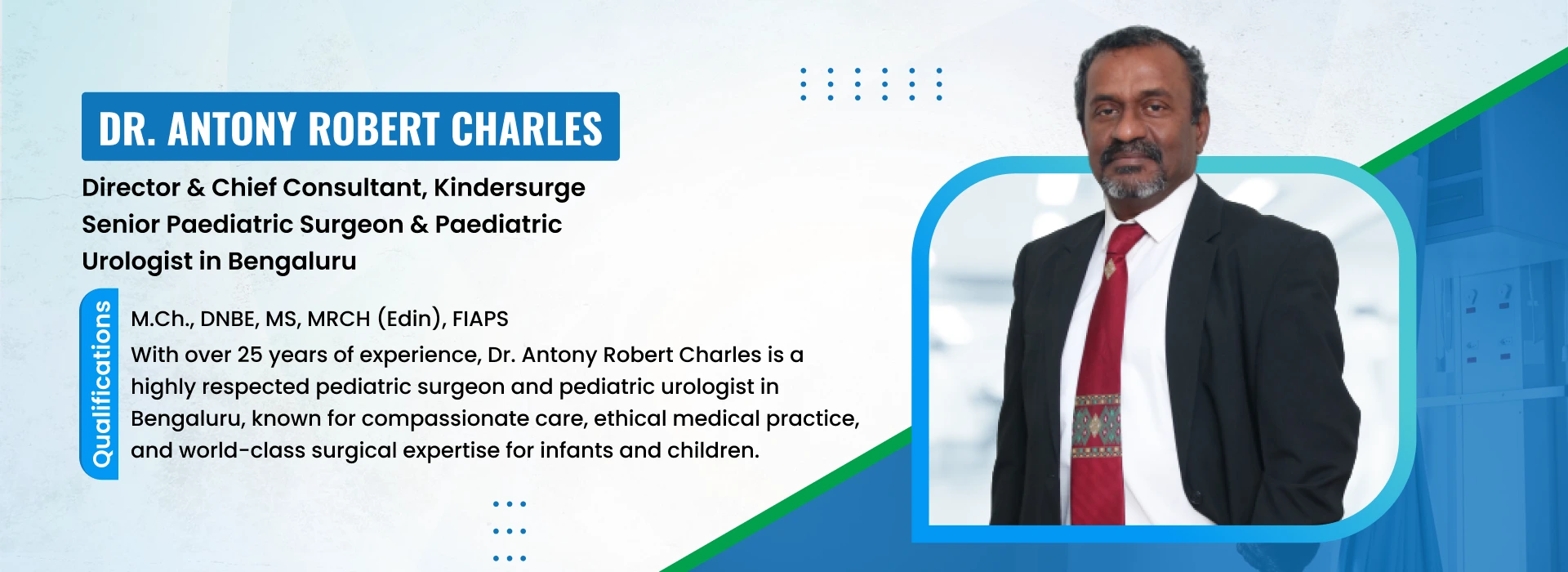
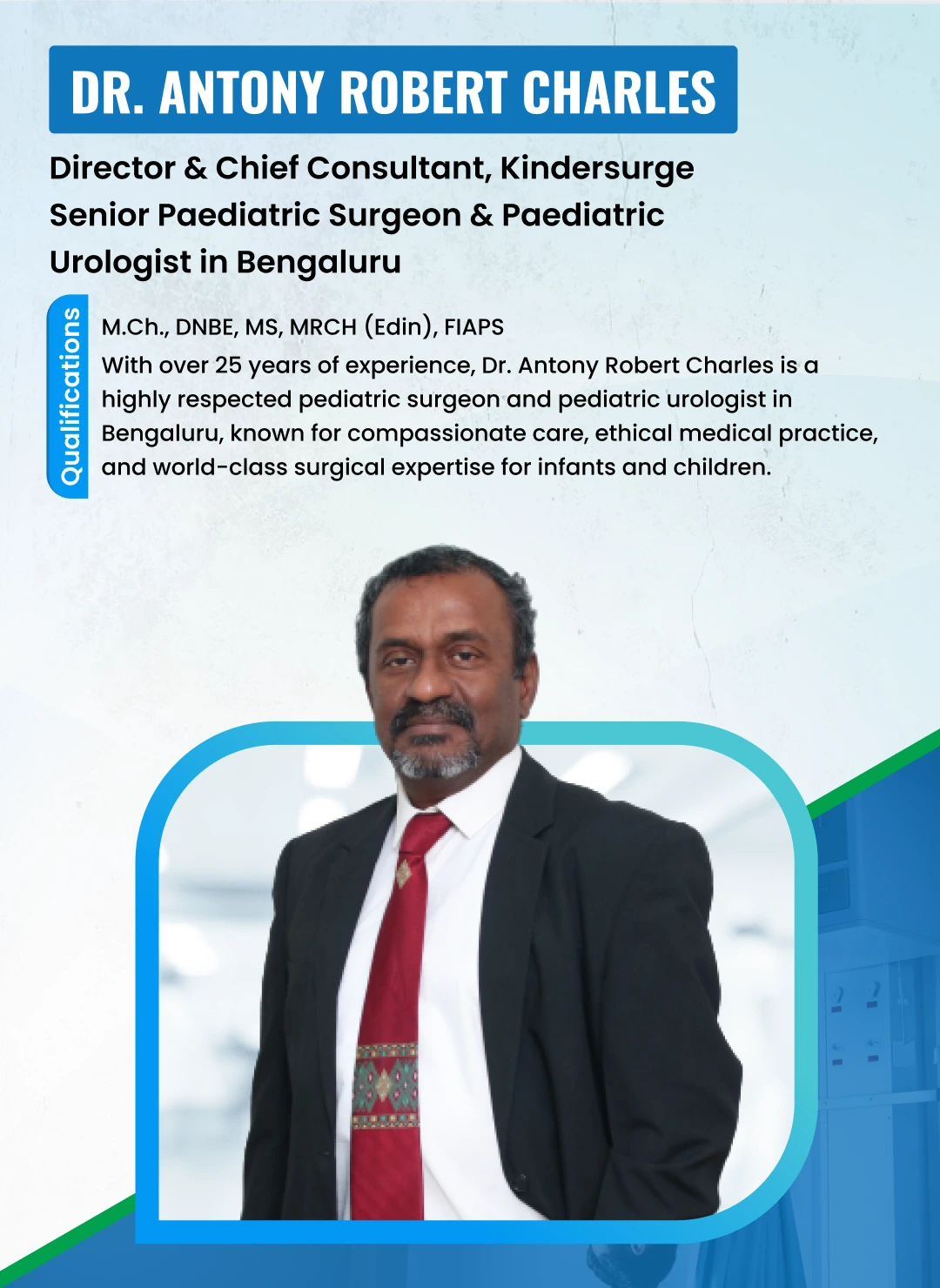
Dr. Antony Robert Charles

Director & Chief Consultant, Pediatric Surgery
Pediatric surgeon in Bangalore
Director & Chief Consultant, Pediatric Surgery

Dr. Antony Robert Charles is the Director & Chief Consultant at KinderSurge, Bengaluru, and a highly respected pediatric surgeon and pediatric urologist with over 25 years of experience. He specialises in pediatric laparoscopy, urological reconstructive surgeries, and neonatal surgical emergencies, delivering advanced, child-focused surgical care.

Internationally trained and deeply committed to ethical medical practice, Dr. Robert is known for combining clinical excellence with compassion. Beyond surgery, he is a TEDx speaker, medical ethicist, and the founder of the ChildFirst Foundation, working to ensure humane, ethical, and world-class healthcare for children.

Dr. Antony Robert Charles – Experienced Best Pediatric Surgeon in Bangalore providing expert surgical care for newborns, children, and adolescents with a compassionate, child-focused approach.

+
Years of Experience
+
Successful Surgeries
+
Children Treated
Languages Spoken
+
Years of Experience
+
Successful Surgeries
+
Children Treated
Languages Spoken

Hypospadias & Undescended Testis Surgery in Bangalore | Dr. Antony Robert Charles

If your child’s doctor has mentioned hypospadias or an undescended testis, you probably have a hundred questions — and a heart full of worry. You are not alone. These are among the most common pediatric surgical conditions in boys, and with the right specialist, they are very treatable. Dr. Antony Robert Charles, a leading pediatric surgeon in Bangalore, helps families across Whitefield, Marathahalli, Koramangala, Hebbal, and Sarjapur Road navigate this journey with expertise and compassion.

What Are Hypospadias and Undescended Testis?

Hypospadias is a birth defect in boys where the urinary opening (urethra) is not at the tip of the penis but somewhere along the underside. It is one of the most common congenital conditions, affecting approximately 1 in 200 newborn boys.

Undescended testis (also called cryptorchidism) is a condition where one or both testicles fail to move into their correct position in the scrotum before birth. It affects about 3–5% of full-term male newborns and up to 30% of premature boys.

Both conditions are correctable with surgery, ideally performed in early childhood for the best long-term outcomes.

Hypospadias Surgery in Bangalore

What Is Hypospadias?

Hypospadias occurs when the tube that carries urine (urethra) forms incompletely during fetal development. Instead of opening at the tip of the penis, the urethral opening may be located:

  • Distal (mild): Near the head or middle of the penis shaft
  • Midshaft (moderate): Along the middle of the shaft
  • Proximal (severe): Near the base of the penis or scrotum

In many cases, the penis may also appear curved downward — a condition called chordee.

Signs and Symptoms of Hypospadias

As a parent, you may notice:
  • The urinary opening is not at the tip of the penis
  • Your baby boy has a downward curve to the penis (chordee)
  • The foreskin looks incomplete or “hooded” at the top
  • Your son sprays urine in unusual directions or must sit to urinate
  • A visible notch or groove on the underside of the penis
⚠️ Important: Hypospadias is typically identified at birth during a routine newborn examination. If you notice any of these signs later, consult a pediatric surgeon immediately.

What Causes Hypospadias?

The exact cause is not always known, but contributing factors include:
  • Hormonal factors during fetal development
  • Genetic factors — it can run in families
  • Environmental exposures during pregnancy
  • Premature birth or low birth weight
  • Certain fertility treatments (IVF)
Most importantly: hypospadias is not caused by anything a mother did during pregnancy.

Diagnosing Hypospadias

Hypospadias is diagnosed by physical examination. No special tests are usually needed for distal forms. For proximal (severe) hypospadias, Dr. Antony Robert Charles may recommend:
  • Ultrasound of the kidneys and urinary tract
  • Hormonal evaluation if the genitalia are ambiguous
  • Genetic testing in complex cases

Hypospadias Treatment: Surgery (Urethroplasty)

Surgery is the only effective treatment for hypospadias. The goal is to:
  1. Straighten the penis (correct chordee)
  2. Reconstruct the urethra so it opens at the tip
  3. Create a natural-looking, functional penis

When should surgery be done? The ideal age for hypospadias repair is between 6 and 18 months, before the child has memory of the procedure and during a time of optimal tissue quality. However, surgery can be performed at any age.

Types of Hypospadias Repair:
Type Best For
MAGPI (Meatal Advancement and Glanuloplasty) Distal (mild) hypospadias
Tubularized Incised Plate (TIP/Snodgrass) Distal and mid-shaft hypospadias
Buccal mucosal graft urethroplasty Severe/proximal or redo hypospadias
Two-stage repair Complex or severe cases
Dr. Antony Robert Charles individualizes the surgical approach for every child. He uses the finest suture materials and surgical techniques to minimize complications and maximize cosmetic and functional outcomes.

What to Expect: Hypospadias Surgery Recovery

  • Duration of surgery: 1–3 hours depending on severity
  • Hospital stay: Usually 1–2 days
  • Urinary catheter: Left in place for 5–10 days after surgery
  • Return to normal activity: 2–4 weeks
  • Follow-up: At 1 week, 1 month, 3 months, and yearly as needed
At home, parents should:
  • Keep the surgical area clean and dry
  • Give prescribed antibiotics and pain relief
  • Avoid tub baths until the catheter is removed
  • Watch for signs of infection (redness, fever, foul smell)

Undescended Testis Treatment in Bangalore

What Is an Undescended Testis?

During fetal development, the testicles form inside the abdomen and gradually travel down into the scrotum. If one or both testicles stop along this path, the condition is called undescended testis or cryptorchidism.

It is classified as:

  • Palpable: The testicle can be felt outside the scrotum (in the groin)
  • Non-palpable: The testicle cannot be felt (may be inside the abdomen, very small, or absent)

Signs and Symptoms of Undescended Testis

You or your pediatrician may notice:

  • One or both sides of the scrotum appear flat or empty
  • The scrotum looks smaller or underdeveloped on the affected side
  • You can feel a lump in the groin area (the testicle sitting in the inguinal canal)
  • The baby’s scrotum is asymmetrical

⚠️ Note: Some testicles are “retractile” — they move up and down and are not truly undescended. A pediatric surgeon can assess this accurately. Do not wait beyond 6 months of age without a specialist’s evaluation.

What Causes Undescended Testis?

  • Prematurity — the most common cause; descent often completes after birth
  • Hormonal imbalance during fetal development
  • Genetic factors
  • Anatomical abnormalities of the groin or testicle
  • Mother’s exposure to certain environmental chemicals

Why Does Undescended Testis Need Treatment?

Left untreated, undescended testis can lead to:

  • Infertility — testicular temperature inside the body is too high for healthy sperm production
  • Increased risk of testicular cancer (2–8x higher if untreated)
  • Testicular torsion (twisting, a surgical emergency)
  • Hernia in the groin area
  • Psychological impact in older boys

Early treatment greatly reduces these risks.

Diagnosing Undescended Testis

  • Physical examination by a trained pediatric surgeon
  • Ultrasound (useful but not always definitive for non-palpable testes)
  • Laparoscopy — the gold standard for non-palpable testes to locate the testicle inside the abdomen

Undescended Testis Treatment: Orchidopexy Surgery

Orchidopexy is the surgical procedure to bring the testicle down into the scrotum and fix it in place.

When should surgery be done? The current recommendation is before 12–18 months of age and ideally no later than 2 years. Early surgery preserves fertility potential and reduces cancer risk.

Types of Orchidopexy:

ProcedureUsed When
Standard (open) orchidopexyPalpable testis in the groin
Laparoscopic orchidopexyNon-palpable (abdominal) testis
Fowler-Stephens orchidopexy (1 or 2 stage)High abdominal testis with short blood vessels

Dr. Antony Robert Charles performs both open and laparoscopic orchidopexy with precision. Laparoscopic surgery means smaller incisions, less pain, and faster recovery for your child.

What to Expect: Orchidopexy Recovery

  • Duration of surgery: 30–90 minutes
  • Hospital stay: Usually day-care or 1 overnight stay
  • Pain: Mild; managed with oral medications
  • Return to normal activity: 1–2 weeks
  • Follow-up: At 1 month, 6 months, and annually through adolescence

Emergency Warning Signs — When to Seek Immediate Help

Call your doctor or go to the emergency room immediately if your child has:

For Hypospadias (Post-Surgery):

  • High fever (above 38.5°C / 101.3°F)
  • Complete inability to urinate
  • Heavy bleeding from the surgical site
  • Catheter has come out accidentally
  • Severe swelling or pus at the wound site

For Undescended Testis (Any Age):

  • Sudden, severe groin or scrotal pain — this could be testicular torsion, a surgical emergency
  • Swelling and redness of the scrotum
  • Nausea or vomiting with groin pain
  • A hard lump felt in the scrotum or groin in an older boy
🚨 Testicular torsion is a surgical emergency. If not treated within 4–6 hours, the testicle may be lost permanently. Do not wait — go to the nearest emergency department immediately.

📞 Book a Consultation — We're Here to Help

Your child’s health cannot wait. Early treatment means better outcomes.

If your baby has been diagnosed with hypospadias or undescended testis — or if you have any concerns — please don’t delay.

🟢Schedule Your Appointment Today

📍 Clinic Location: [Insert Address], Bangalore

 Consultation: Available for parents across Bangalore, including Whitefield, Koramangala, Marathahalli, Hebbal, and Sarjapur Road 

First consultation for hypospadias and undescended testis is available .

Serving Families Across Bangalore — Local Relevance

Dr. Antony Robert Charles provides specialized pediatric surgical care to families across Bangalore. Whether you live in the IT corridors of Whitefield and Marathahalli, the vibrant neighborhoods of Koramangala, the growing localities of Hebbal, or the residential communities along Sarjapur Road — expert pediatric surgery is accessible to you.

Hypospadias & Undescended Testis Specialist Near You

Your AreaWhat Parents Search
WhitefieldHypospadias surgeon near Whitefield, undescended testis treatment Whitefield
MarathahalliPediatric urology Marathahalli, undescended testis surgery near Marathahalli
KoramangalaHypospadias repair Koramangala, best pediatric surgeon Koramangala
HebbalUndescended testis specialist Hebbal, hypospadias doctor near Hebbal
Sarjapur RoadPediatric surgeon Sarjapur Road, cryptorchidism treatment Sarjapur

Many of Dr. Antony Robert Charles’s patients travel from across Bangalore, including Indiranagar, HSR Layout, Electronic City, Yelahanka, and Jayanagar, to receive specialized pediatric surgical care.

Frequently Asked Questions:

Q: What is hypospadias?

Hypospadias is a congenital condition in boys where the urinary opening (meatus) is located on the underside of the penis rather than at the tip. It may also be associated with a downward curve of the penis. It is correctable with surgery, typically performed between 6 and 18 months of age.

Q: What is undescended testis?

Undescended testis (cryptorchidism) is a condition where one or both testicles have not moved into the scrotum before birth. It is the most common genitourinary birth defect in boys and requires surgical treatment (orchidopexy) before 18 months of age.

Q: Is hypospadias surgery safe for infants?

Yes. Hypospadias surgery is routinely and safely performed on infants between 6 and 18 months. At this age, anesthesia is well-tolerated, tissues heal quickly, and the child has no memory of the experience. Dr. Antony Robert Charles performs these procedures with pediatric-specific anesthetic and surgical protocols.

Q: At what age should undescended testis be treated?

Undescended testis should ideally be treated surgically (orchidopexy) between 6 and 18 months of age, and no later than 2 years of age. Early treatment preserves fertility and significantly reduces the long-term risk of testicular cancer.

Q: Will my son be able to have children after hypospadias surgery?

Yes, in the vast majority of cases. When hypospadias is corrected surgically with proper technique, fertility is not affected. The urethra is reconstructed to function normally, allowing both urination and, in adulthood, normal sexual function and fertility.

Q: Will undescended testis affect my son's fertility?

If treated early (before 18 months), the risk to fertility is significantly reduced. Untreated undescended testis, especially bilateral cases, can lead to reduced sperm count and fertility problems. Early orchidopexy by an experienced pediatric surgeon gives the best outcomes.

Q: How do I know if my baby has hypospadias?

Hypospadias is usually identified at birth during a newborn physical examination. Signs include the urinary opening not being at the tip of the penis, a hooded foreskin, or a curved penis. If you notice these signs, consult a pediatric surgeon for evaluation.

Q: Is the surgery done under general anesthesia?

Yes. Both hypospadias repair and orchidopexy are performed under general anesthesia. Pediatric anesthesia is extremely safe when administered by trained pediatric anesthesiologists. Dr. Antony Robert Charles works with experienced pediatric anesthesia teams to ensure your child's safety and comfort.

Q: How long does hypospadias surgery take?

Hypospadias surgery typically takes between 1 and 3 hours, depending on the severity and the type of repair required. Mild (distal) hypospadias may be corrected in under an hour, while complex (proximal) cases or redo surgeries may take longer.

Q: Where is the best place for pediatric urology surgery in Bangalore?

Dr. Antony Robert Charles is a highly experienced pediatric surgeon in Bangalore offering specialized care for hypospadias and undescended testis. He serves families across Bangalore including Whitefield, Marathahalli, Koramangala, Hebbal, and Sarjapur Road.

```
Patient Education

Evidence-Based Insights for Parents

Pediatric Consultant

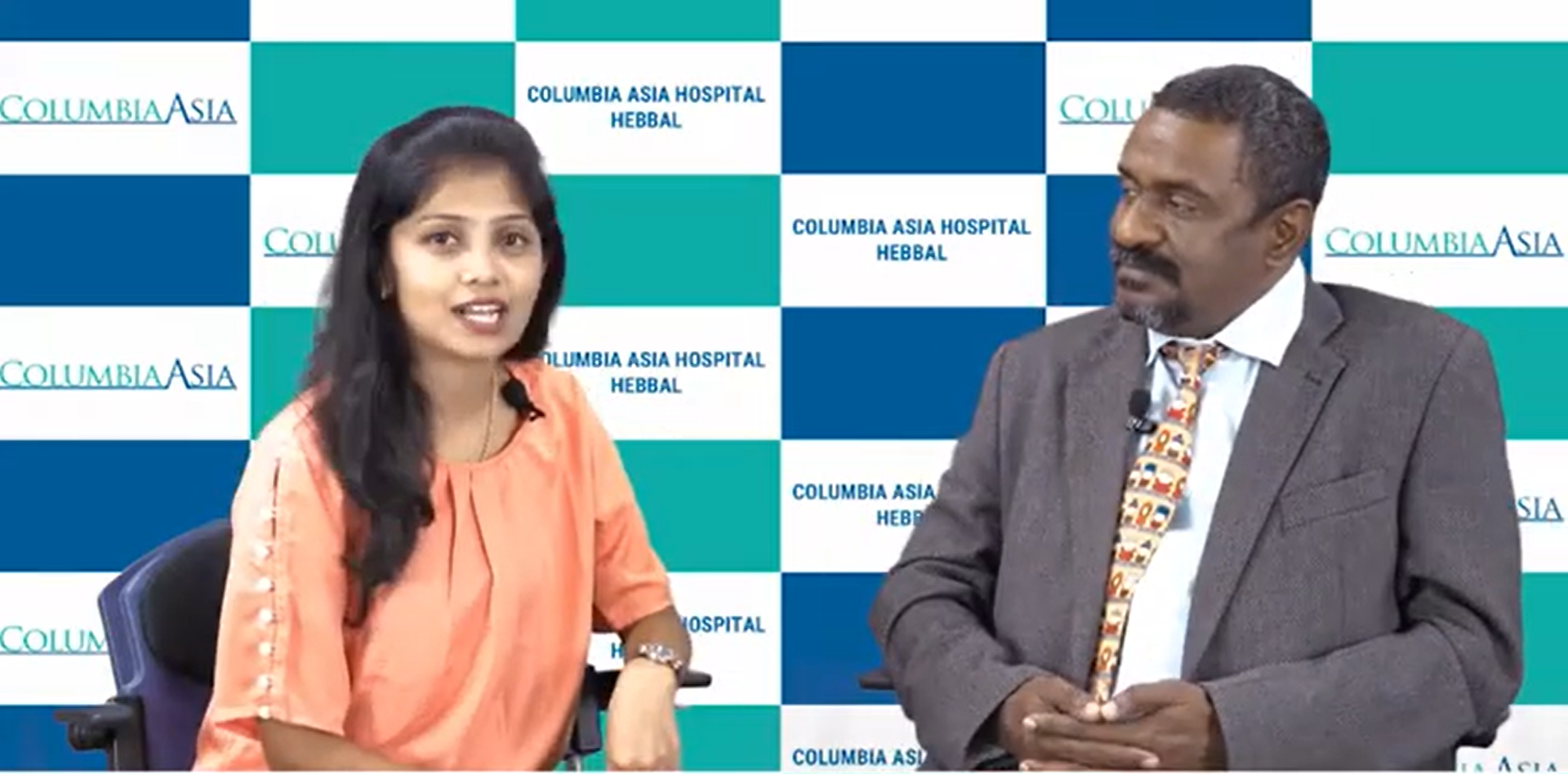
Dr. Antony Robert Charles Discusses Surgery in Children

Get more info

EMERGENCY CALL

Get a helpful insight

Read Out The Blogs

Health Tip

Little Tips for Big Health

Dr. Antony Robert Charles

4 Videos

Why Choose Dr. Antony Robert Charles for Pediatric Surgery in Bangalore?

About Dr. Antony Robert Charles — Pediatric Surgeon, Bangalore

Dr. Antony Robert Charles is a highly qualified and compassionate pediatric surgeon in Bangalore with specialized expertise in pediatric urology, including hypospadias repair and orchidopexy for undescended testis.

Why families trust Dr. Antony Robert Charles:

  • Specialized Expertise in pediatric urology and genital reconstructive surgery
  • High-volume experience with hundreds of successful hypospadias and undescended testis surgeries
  • Child-first approach — all decisions are made considering the long-term wellbeing of your child
  • Parent education — every family receives a thorough explanation of the diagnosis and surgery plan before proceeding
  • Modern surgical techniques including laparoscopic orchidopexy and TIP urethroplasty
  • Transparent communication — no medical jargon, no rushed consultations
  • Dedicated follow-up care to monitor outcomes through adolescence
  • Accessible location — easily reachable from Whitefield, Marathahalli, Koramangala, Hebbal, and Sarjapur Road

“As a parent, you want the absolute best for your child. We understand that completely. Every child who comes to us is treated with the same care, precision, and compassion as our own.” — Dr. Antony Robert Charles