

Pediatric surgeon in Bangalore

Meet Our Lead Pediatric surgeon in Bangalore

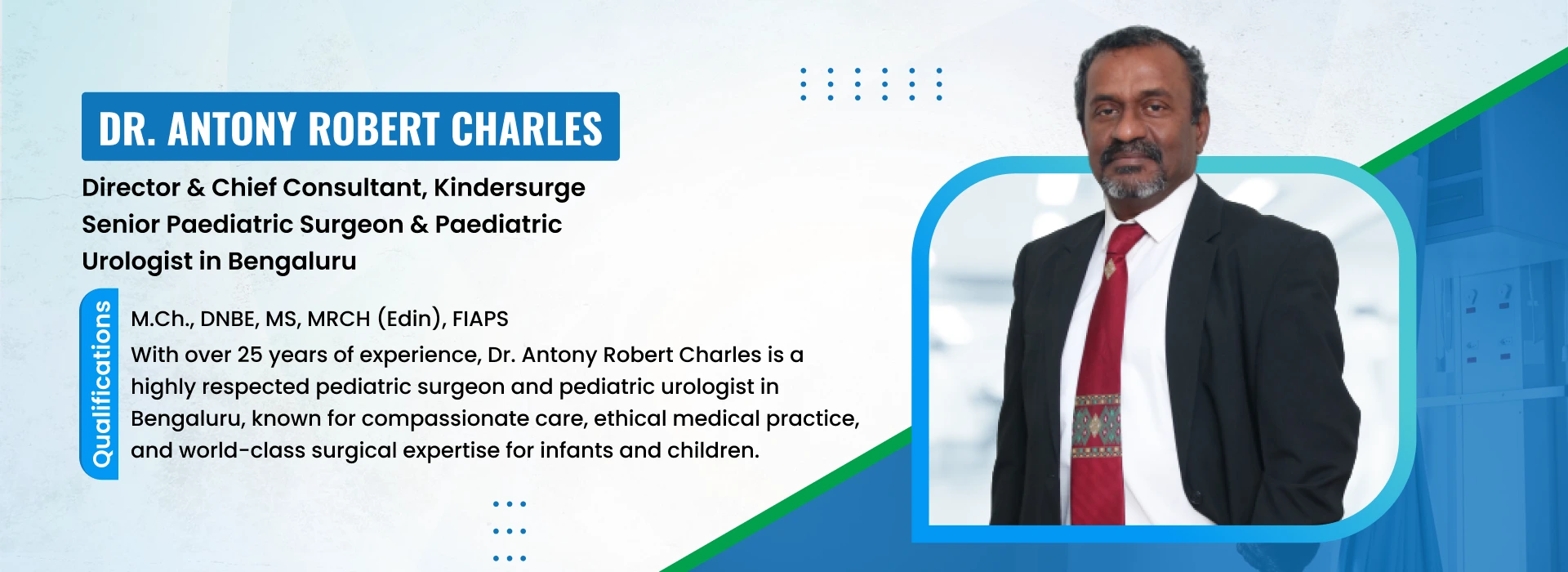
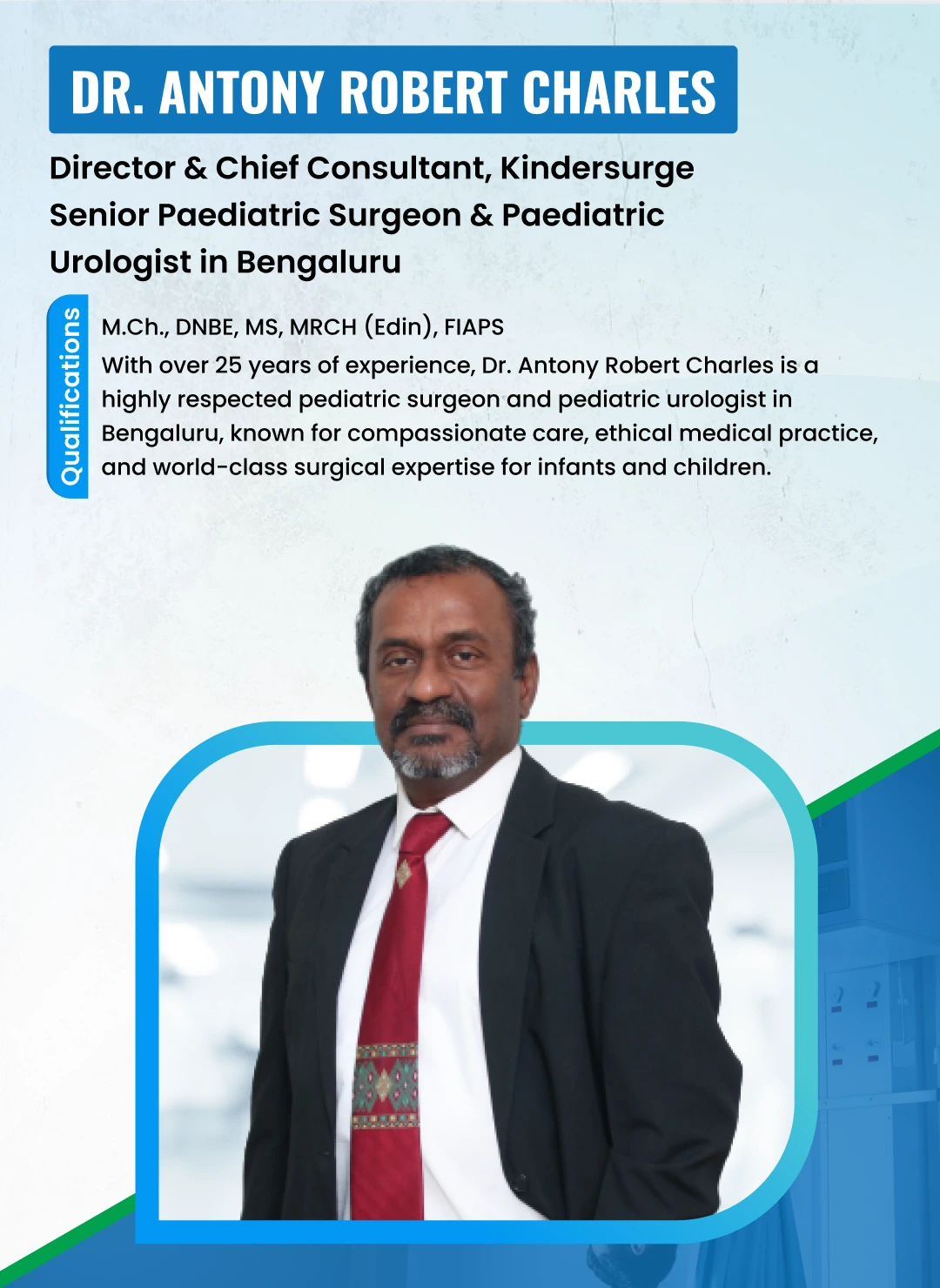
Dr. Antony Robert Charles

Director & Chief Consultant, Pediatric Surgery
Pediatric surgeon in Bangalore
Director & Chief Consultant, Pediatric Surgery

Dr. Antony Robert Charles is the Director & Chief Consultant at KinderSurge, Bengaluru, and a highly respected pediatric surgeon and pediatric urologist with over 25 years of experience. He specialises in pediatric laparoscopy, urological reconstructive surgeries, and neonatal surgical emergencies, delivering advanced, child-focused surgical care.
Internationally trained and deeply committed to ethical medical practice, Dr. Robert is known for combining clinical excellence with compassion. Beyond surgery, he is a TEDx speaker, medical ethicist, and the founder of the ChildFirst Foundation, working to ensure humane, ethical, and world-class healthcare for children.

Dr. Antony Robert Charles – Experienced Best Pediatric Surgeon in Bangalore providing expert surgical care for newborns, children, and adolescents with a compassionate, child-focused approach.

+
Years of Experience
+
Successful Surgeries
+
Children Treated
Languages Spoken
+
Years of Experience
+
Successful Surgeries
+
Children Treated
Languages Spoken

Hypospadias Surgery & Undescended Testis Treatment in Hebbal, Bangalore — Dr Antony Robert Charles

Expert Care for Your Son’s Most Sensitive Concerns

Discovering that your newborn son has hypospadias or an undescended testicle can feel overwhelming. You may have questions, fears, and uncertainty about what lies ahead. The good news is this: both conditions are well understood, highly treatable, and with the right surgeon, outcomes are excellent.

Dr Antony Robert Charles, a specialist paediatric surgeon and urologist in Hebbal, Bangalore, has performed hundreds of hypospadias repairs and orchidopexy procedures. He works with anxious parents every day — explaining everything clearly, performing surgery with precision and care, and guiding your family from diagnosis through to full recovery.

Families travel from Whitefield, Marathahalli, Koramangala, Sarjapur Road, and across Bangalore to trust Dr Antony with their sons’ care. Here is everything you need to know.

Hypospadias is a birth defect in boys where the urinary opening is on the underside of the penis rather than the tip. Undescended testis (cryptorchidism) is when one or both testes have not moved into the scrotum by 6 months of age. Both conditions require surgical correction — hypospadias repair (urethroplasty) and orchidopexy — ideally between 6 and 18 months of age. In Hebbal, Bangalore, Dr Antony Robert Charles is a leading specialist for both procedures.

What Is Hypospadias?

Hypospadias is one of the most common birth defects affecting boys, occurring in approximately 1 in every 200–300 male births. It happens during foetal development when the urinary tube (urethra) does not fully form along the length of the penis. As a result:

  • The urinary opening (meatus) is not at the tip of the penis — it may be on the underside of the penile head, along the shaft, or at the base
  • The foreskin may be incompletely formed, giving a “hooded” appearance
  • The penis may curve downward — a condition called chordee

Hypospadias is not caused by anything the mother did or didn’t do during pregnancy. It is a developmental variation, and it is entirely correctable with surgery.

Semantic Keywords: hypospadias treatment Bangalore, hypospadias repair Hebbal, hypospadias surgeon Bangalore, urethroplasty child Bangalore, hypospadias baby boy Bangalore, chordee correction Bangalore

Types of Hypospadias — Understanding the Severity

Not all hypospadias are the same. The location of the urinary opening determines the type:

Type

Opening Location

Complexity

Glanular / Coronal

Near the tip of the penis

Mild — single stage repair

Distal Penile

Middle of the penile shaft

Mild to moderate — single stage

Mid-shaft

Mid-shaft of the penis

Moderate — single stage or two-stage

Proximal / Penoscrotal

Where penis meets scrotum

Severe — usually two-stage repair

Perineal

At the base, between scrotum

Severe — two-stage repair

Dr Antony evaluates each child individually. Approximately 70–80% of hypospadias cases are distal (mild) and can be corrected in a single surgery.

Symptoms & Signs of Hypospadias — What Parents Notice

Many cases are diagnosed at birth during routine newborn examination. However, some parents first notice:

  • The urinary opening is not at the tip of the penis — it is on the underside or base
  • The foreskin is not complete — it forms a hood only on the top of the penis
  • The penis bends downward (chordee) — noticeable when erect
  • The urine stream is abnormal — sprays sideways, downward, or is difficult to aim
  • The child has to sit down to urinate due to the direction of the stream
  • In older uncircumcised boys, recurrent infections under the foreskin

Important: If your newborn has been advised against circumcision at birth, this is often because the foreskin tissue is needed for the hypospadias repair. Do not have your son circumcised before seeing Dr Antony — the foreskin is valuable surgical material.

What Causes Hypospadias?

Hypospadias develops during weeks 8 to 14 of pregnancy, when the urethra is forming. Exact causes are not always identified, but contributing factors include:

  • Genetic factors — family history of hypospadias (father or brother affected)
  • Hormonal influences — disruption in androgen (male hormone) activity during foetal development
  • Environmental factors — exposure to certain endocrine-disrupting chemicals during pregnancy (though evidence is still emerging)
  • Prematurity and low birth weight — associated with higher incidence
  • Maternal age over 35 — slightly increased risk
  • Assisted reproduction (IVF/ICSI) — marginally higher incidence reported in some studies

There is no single identifiable cause in the majority of cases, and parents should not feel responsible.

Diagnosis of Hypospadias

  • Hypospadias is a clinical diagnosis — it is identified by physical examination. No special tests are needed for straightforward cases.

    At birth: Most cases are identified during the newborn check by the neonatologist or paediatrician.

    Additional investigations may be required when:

    • Hypospadias is associated with undescended testes (both together may suggest a disorder of sexual development — DSDs — requiring chromosomal testing and hormone evaluation)
    • Severe proximal or perineal hypospadias where gender evaluation is indicated
    • Urethrogram or voiding cystourethrogram (VCUG) if urinary tract abnormalities are suspected

    Dr Antony reviews each child thoroughly and orders investigations only when clinically necessary.

Recovery After Hypospadias Surgery — A Parent's Guide

First 48 Hours:

  • Expect some swelling, bruising, and discomfort — this is normal
  • Pain is managed with paracetamol and ibuprofen — rarely needs stronger medication
  • Keep the nappy area clean and dry; avoid baths (sponge bath only while catheter is in)
  • The catheter drains urine continuously — no need for the child to “try to wee”

Days 3–14 (Catheter In Place):

  • Antibiotics are prescribed to prevent infection while the catheter is in situ
  • Keep the dressing intact and dry
  • Restrict vigorous activity — no playground, swimming, or rough play
  • Most babies and toddlers are back to their normal happy selves within 3–5 days

Catheter Removal (Day 7–14):

  • Removed in clinic — usually quick and well-tolerated
  • First few voids may cause brief discomfort — normal
  • Observe the urine stream direction and force

Weeks 2–6:

  • Swelling resolves gradually over 4–6 weeks
  • Avoid baths and swimming pools for 4 weeks after catheter removal
  • Follow-up appointments at 6 weeks, 3 months, and 1 year post-surgery

Long-Term Outcome: The vast majority of boys after successful hypospadias repair have:

  • A normal-appearing penis with the urinary opening at the tip
  • A straight, normal erection
  • A normal forward urine stream — able to stand and urinate
  • Normal sexual function in adulthood
  • Normal fertility

Hypospadias Surgery (Urethroplasty) — What to Expect

When Is the Best Time for Surgery?

The ideal age for hypospadias repair is 6 to 18 months. At this age:

  • The penis is hormonally primed (testosterone stimulation can be used before surgery if needed)
  • General anaesthesia risk is low with a paediatric anaesthetist
  • The child has no memory of the procedure
  • Healing is faster and more complete
  • Psychological impact is minimised

How Is Hypospadias Surgery Performed?

Single-Stage Repair (TIP — Tubularised Incised Plate Urethroplasty): Used for most distal and mid-shaft hypospadias. In one operation, Dr Antony:

  1. Corrects the downward curvature (chordee) if present
  2. Reconstructs the urethra using local tissue, extending it to the tip of the penis
  3. Reshapes the glans (penile head) to a normal, conical appearance
  4. Reconstructs the foreskin or performs a cosmetic repair

Two-Stage Repair: Required for severe proximal, penoscrotal, or perineal hypospadias:

  • Stage 1 (6–18 months): Chordee correction and skin grafting using foreskin or buccal mucosa (inner cheek lining)

Stage 2 (6 months later): Urethral tube construction using the grafted tissue

What Happens on the Day of Surgery?

  • Admission on the day of surgery (most cases)
  • General anaesthesia by a paediatric anaesthetist
  • Surgery duration: 1.5 to 3 hours depending on complexity
  • A urinary catheter is left in place for 7–14 days to allow the new urethra to heal
  • Discharge is usually same day or next morning
  • A protective dressing around the penis is applied

Warning Signs After Hypospadias Surgery — Seek Help Immediately

Contact Dr Antony or go to emergency if you notice:

  • No urine output for more than 4–6 hours with catheter in place — possible blockage
  • Fever above 38.5°C — possible infection
  • Pus or foul-smelling discharge from the surgical site
  • Bleeding that does not stop with gentle pressure
  • The catheter falls out before the planned removal date — call immediately
  • Swelling that is severe, worsening, or spreading beyond the surgical area
  • Urine leaking from a site other than the catheter — possible fistula formation
  • Child is inconsolable or showing signs of extreme pain

What Is an Undescended Testis? 

During pregnancy, the testes form inside the abdomen and gradually descend into the scrotum through the inguinal canal. This process should be complete by birth or within the first 3–6 months of life.

When a testicle fails to reach the scrotum, it is called an undescended testis or cryptorchidism — from the Greek words for “hidden testis.”

  • It occurs in approximately 3–4% of full-term boys at birth
  • In premature babies, the incidence is higher (up to 30%) — but many descend spontaneously in the first months of life
  • About 80% of undescended testes that are present at birth descend on their own by 3 months of age
  • If a testis has not descended by 6 months, spontaneous descent is unlikely and surgery is recommended

Symptoms & Signs of Undescended Testis — What Parents Notice

  • Empty scrotum on one or both sides — the scrotum looks underdeveloped or flat on one side
  • Scrotum appears smaller or less full on one side compared to the other
  • Cannot feel the testicle inside the scrotum during bathing or nappy change
  • A testicle that was in the scrotum but seems to disappear — this may be a retractile testis (moves up into the groin in cold or during examination but comes back)
  • Swelling or fullness in the groin — the testis may be palpable in the inguinal canal

Note on Retractile Testis: Some boys have a “retractile” testis — one that goes up and down. This is a normal variant but requires annual monitoring to ensure it does not become an ascending testis (one that permanently migrates upward over time).

Diagnosis of Undescended Testis

Physical Examination is the primary diagnostic tool. Dr Antony performs a careful, warm-handed examination to locate the testis.

Ultrasound can locate testes in the inguinal canal but is unreliable for intra-abdominal testes — a negative ultrasound does not rule out an abdominal testis.

Laparoscopy (diagnostic) — if the testis cannot be felt on examination (impalpable testis), laparoscopy is the gold standard to locate and assess it. This is done under general anaesthesia and can often proceed to therapeutic laparoscopic orchidopexy in the same sitting.

Hormonal tests (hCG stimulation test) — occasionally used to confirm the presence of functional testicular tissue when both testes are absent.

Where Can an Undescended Testis Be?

The testis may be located at different points along its descent route:

Location

Description

Frequency

Inguinal canal

Inside the groin, just above the scrotum

Most common (~70%)

Abdominal

Inside the abdomen, at or near the internal inguinal ring

~10–15%

Pre-scrotal

Just above the scrotum

Common, often retractile

Ectopic

In an abnormal location (inner thigh, perineum)

Rare

Absent / Vanishing

No testis present — may have been lost in utero

~5%

Why Is Treatment So Important? The Risks of Leaving It Untreated

An undescended testis inside the warm abdomen — away from the cooler temperature of the scrotum — is exposed to conditions that damage sperm-producing cells over time. The longer the testis remains undescended, the greater the damage.

Untreated undescended testis carries these risks:

  1. Infertility Sperm production requires a temperature 2–3°C lower than body temperature — which is why the testes sit outside the body in the scrotum. An abdominal testis is exposed to higher temperatures, progressively damaging sperm-producing cells. If bilateral (both sides) and untreated, infertility is almost certain.
  2. Testicular Cancer An undescended testis has a 3–10 times higher risk of developing testicular cancer in adulthood, even after orchidopexy. However, orchidopexy performed before 18 months of age significantly reduces this risk and — critically — brings the testis into the scrotum where it can be felt and monitored by the patient.
  3. Testicular Torsion An undescended testis is more vulnerable to torsion (twisting), which cuts off blood supply and can destroy the testis within hours.
  4. Inguinal Hernia Almost all undescended testes are associated with a patent processus vaginalis — an opening that predisposes to inguinal hernia, which may need separate repair.
  5. Psychological Impact An empty scrotum causes significant psychological distress in older boys and adolescents. Early surgery eliminates this concern.

📞 Book a Consultation with Dr. Antony Robert Charles —Hypospadias surgery in Hebbal , Bangalore

Your child’s urinary health cannot wait. Neither should you. Whether you’re in Whitefield, Koramangala, Marathahalli, Hebbal, or Sarjapur Road — expert, compassionate pediatric urology care is available for your family.

What to Expect at Your First Visit:

✔ Thorough history and physical examination ✔ Clear explanation of your child’s condition in simple language ✔ A personalized investigation and treatment plan ✔ Honest, evidence-based advice — no unnecessary procedures ✔ Time for all your questions to be answered

📅 Appointment Options:

  • In-Person Consultation — Bangalore clinic (address on contact page)
  • Teleconsultation — Available for initial queries and follow-ups
Emergency Contact — For urgent urological concerns

Trusted by Families Across Bangalore — Local Relevance

Whitefield & ITPL Families

Parents from Whitefield, Brookefield, ITPL, and Mahadevapura regularly consult Dr Antony for hypospadias repair and orchidopexy. The clinic is accessible via the Outer Ring Road and is worth the journey for a specialist with Dr Antony’s level of expertise and experience in these delicate procedures.

Marathahalli & Varthur Families

Many families from Marathahalli, Kundalahalli, and Varthur have trusted Dr Antony Robert Charles with their sons’ urological surgeries. His calm, reassuring approach puts both children and parents at ease through what can feel like a daunting process.

Koramangala & HSR Layout Families

Parents in Koramangala, HSR Layout, Indiranagar, and Jayanagar choose Dr Antony for the combination of specialist expertise, honest communication, and excellent surgical outcomes — especially for redo hypospadias cases referred after complications elsewhere.

Sarjapur Road & Bellandur Families

Families from Sarjapur Road, Bellandur, and Carmelaram travel to Dr Antony’s Hebbal clinic because specialist-grade paediatric urology care is not uniformly available at all local hospitals. The consultation and surgery experience is consistently described by parents as reassuring and thorough.

Hebbal & North Bangalore Families

For families in Hebbal, Yelahanka, Thanisandra, Kalyan Nagar, and HBR Layout, Dr Antony’s clinic provides local access to genuinely specialist-level paediatric urological surgery — without having to navigate Central Bangalore.

Frequently Asked Questions:

What is the best age for hypospadias surgery in children?

The ideal age for hypospadias repair is 6 to 18 months. Surgery at this age offers the best outcomes — the tissue is pliable, healing is rapid, there is no psychological trauma, and hormonal priming can be used before surgery if needed to increase penile size. Dr Antony Robert Charles recommends early referral so planning can begin from 3 months of age.

Will hypospadias affect my son's fertility or sexual life?

A successfully repaired hypospadias does not affect fertility or sexual function. After surgery, the urinary opening is at the tip of the penis, the penis is straight, and normal erection and ejaculation are expected. The key is having the repair performed by an experienced specialist using meticulous techniques to minimise complications and achieve natural-looking results.

My newborn has hypospadias. Should I be worried?

It is completely natural to feel anxious, but hypospadias is one of the most successfully treated birth defects in paediatric surgery. With the right surgeon, the correction is reliable, the recovery is quick, and most boys go on to have a completely normal life. An early consultation helps parents understand the condition and plan surgery at the optimal age.

If one testicle is undescended, will my son be infertile?

If only one testis is undescended and the other is normal, fertility is usually not significantly affected — especially if orchidopexy is performed early. However, untreated bilateral undescended testes can seriously affect fertility. Early surgery remains the most important protective factor.

Can an undescended testis descend on its own without surgery?

Yes — but only up to the age of 6 months. After 6 months, spontaneous descent becomes very unlikely. Delaying treatment beyond this age increases the risk of damage to sperm-producing cells and future complications. Current medical guidelines generally do not recommend routine hormonal therapy due to limited effectiveness.

My son is 3 years old and has an undescended testis. Is it too late for surgery?

No, it is not too late. Surgery should still be performed as soon as possible. While the ideal age is before 18 months, orchidopexy in older children still helps reduce long-term risks and preserves testicular function. Early specialist evaluation remains important regardless of age.

Will my son need general anaesthesia for these surgeries?

Yes. Both hypospadias repair and orchidopexy are performed under general anaesthesia administered by trained paediatric anaesthetists. These procedures are considered very safe in otherwise healthy children. Most children are discharged the same day or after a short overnight stay.

What is the difference between a retractile testis and a true undescended testis?

A retractile testis moves temporarily into the groin due to an active cremasteric reflex but can be gently brought back into the scrotum. A true undescended testis cannot be fully positioned within the scrotum. Retractile testes usually do not need surgery but should be monitored regularly as some may become ascending testes over time.

Is redo hypospadias surgery possible if a previous repair failed?

Yes. Revision hypospadias surgery is a specialised area of paediatric urology. Problems such as fistula formation, narrowing of the urinary opening, or urethral strictures can often be corrected successfully using advanced reconstructive techniques, including tissue grafts when necessary.

How do I find a hypospadias or undescended testis specialist near me in Bangalore?

Dr Antony Robert Charles practises in Hebbal, Bangalore, and is accessible from Whitefield, Marathahalli, Koramangala, Sarjapur Road, and surrounding areas. Families can schedule in-person or teleconsultation appointments for evaluation and treatment planning.

Patient Education

Evidence-Based Insights for Parents

Pediatric Consultant

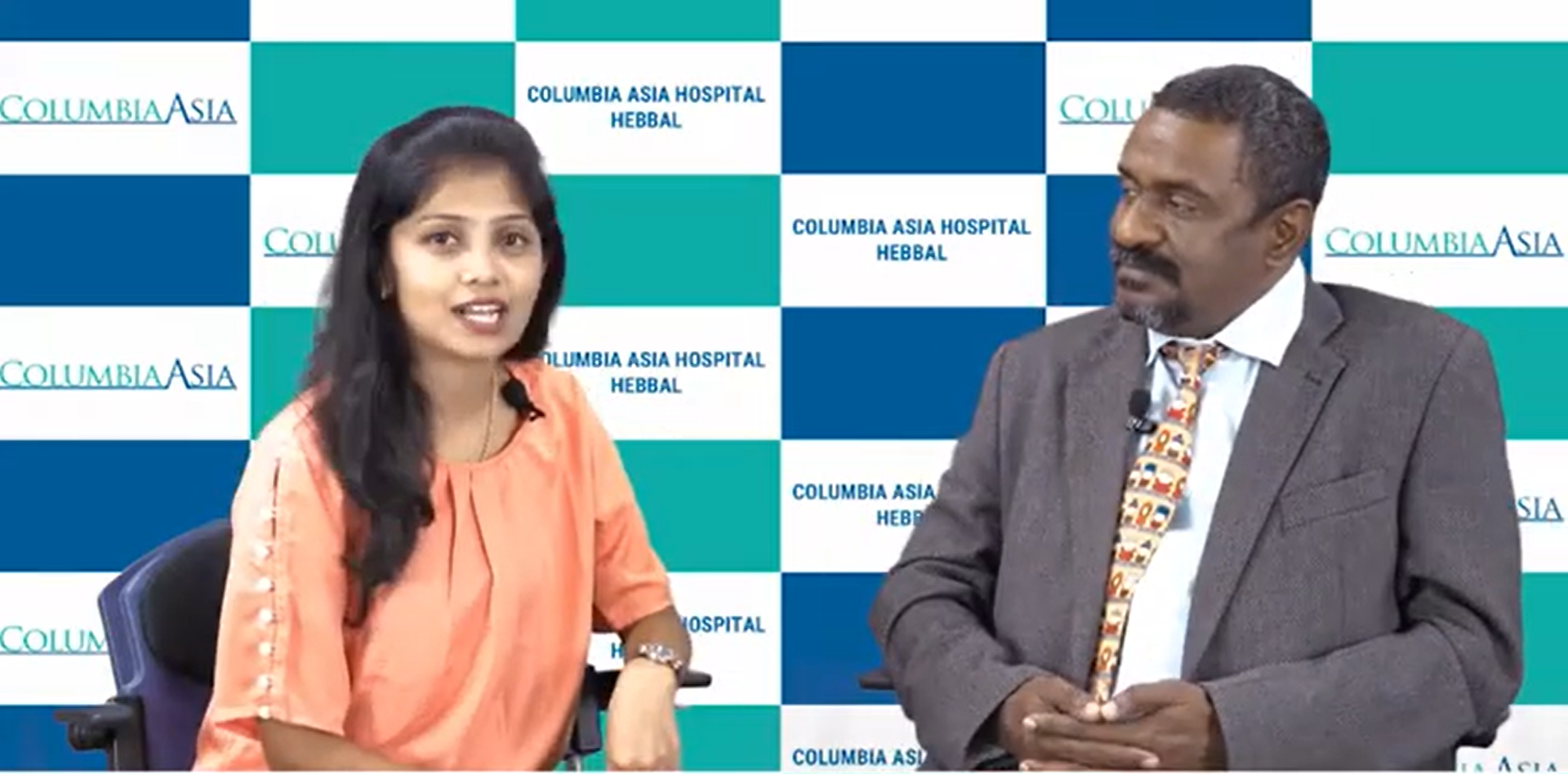
Dr. Antony Robert Charles Discusses Surgery in Children

Get more info

EMERGENCY CALL

Get a helpful insight

Read Out The Blogs

Health Tip

Little Tips for Big Health

Dr. Antony Robert Charles

4 Videos

Why Choose Dr Antony Robert Charles for Hypospadias & Orchidopexy Surgery?

Specialised Expertise in Paediatric Urology

Dr Antony holds an MCh in Paediatric Surgery and a Fellowship in Paediatric Urology, with specific advanced training in hypospadias repair and orchidopexy. He has performed hundreds of these procedures across all levels of complexity — from routine distal hypospadias to challenging redo cases and high intra-abdominal testes.

Meticulous Surgical Technique

Hypospadias repair in particular is a procedure where surgical technique makes an enormous difference to outcomes. Dr Antony uses operating loupes and fine instruments to achieve precise, watertight urethral construction — minimising the risk of fistula, stricture, and the need for redo surgery.

Honest Assessment — Not Every Case Needs Immediate Surgery

Dr Antony is honest about the natural history of conditions. A retractile testis does not need surgery. Mild glanular hypospadias in some cases may not require repair. He discusses the options openly so parents can make informed, unhurried decisions for their child.

Child-Friendly, Parent-Centred Consultations

A diagnosis of hypospadias or undescended testis is frightening. Dr Antony takes as much time as needed to explain the anatomy, show diagrams, walk through the surgical plan, and answer every question — including the ones parents feel embarrassed to ask.

Seamless Care from Diagnosis to Recovery

Dr Antony is involved at every stage: the initial consultation, pre-operative preparation, surgery, ward rounds, catheter removal, and all follow-up visits. You are never handed off to a different doctor mid-treatment.

Credentials & Recognitions

  • MCh Paediatric Surgery
  • Fellowship, Paediatric Urology
  • Member, Indian Association of Paediatric Surgeons (IAPS)
  • Member, Society for Paediatric Urology (India)
  • Visiting Consultant at Leading Hospitals in North Bangalore