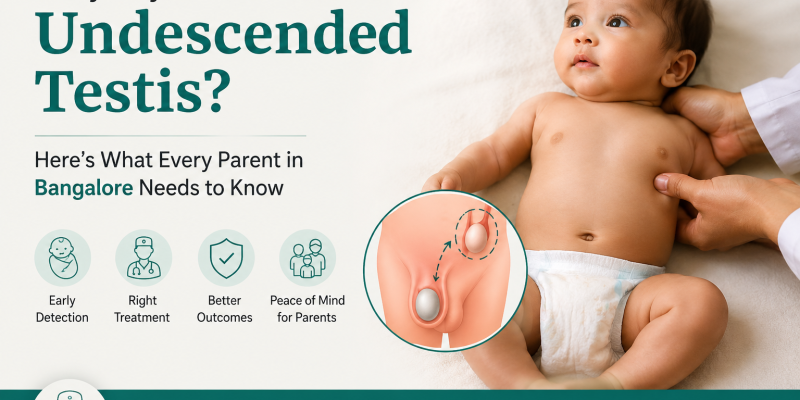
What Is Undescended Testis (Cryptorchidism)?
During pregnancy, a baby boy’s testicles normally develop inside the abdomen and gradually move down into the scrotum before birth. When one or both testicles fail to complete this journey, the condition is called cryptorchidism in infants, more commonly known as an undescended testicle. It affects roughly 1 in 25 to 1 in 30 full-term baby boys, and it’s even more common in babies born prematurely. In many cases, the testicle continues to descend naturally within the first few months of life. However, if it hasn’t descended by around 6 months of age, it usually won’t do so on its own — and this is when medical evaluation becomes important.Causes of Undescended Testis in Infants
There isn’t always one single cause. Pediatric urology research points to several contributing factors:- Premature birth — less time in the womb means less time for the testicle to descend.
- Low birth weight, which is often linked to prematurity.
- Family history of undescended testis or other genital development conditions.
- Hormonal factors during pregnancy that affect testicular descent.
- Genetic conditions that affect connective tissue or hormone signalling.
- Restricted space in the abdomen due to conditions like abdominal wall defects.
Symptoms Parents Should Watch For
Because a baby can’t tell you something feels different, parents and pediatricians rely on physical signs. Watch for:- One side of the scrotum appears smaller, empty, or underdeveloped compared to the other.
- You cannot feel the testicle in the scrotal sac during a diaper change or bath.
- The scrotum looks asymmetrical.
- In some babies, both testicles may be absent from the scrotum (bilateral undescended testis), which needs prompt evaluation.
Retractile Testis vs Undescended Testis: What’s the Difference?
This is one of the most common points of confusion for parents, and understanding it can save you unnecessary worry. A retractile testis is a testicle that has descended normally but temporarily pulls up into the groin due to a strong muscle reflex (the cremasteric reflex) — often triggered by cold weather, tickling, or anxiety. It can usually be gently guided back down into the scrotum by a doctor during examination, and it stays there, at least briefly. A true undescended testicle, on the other hand, cannot be brought down into the scrotum at all, or it retracts immediately back up every time.| Feature | Retractile Testis | Undescended Testis |
| Can be manually guided into scrotum | Yes, stays down temporarily | No, or springs back immediately |
| Needs surgery | Usually no, needs monitoring | Often yes, if not resolved by 6 months |
| Long-term risk | Very low | Higher if untreated |
| Follow-up needed | Yearly check-ups recommended | Surgical evaluation needed |
When to Worry About an Undescended Testicle
So, when to worry about undescended testicle presentations? Here’s a simple guide:- If the testicle hasn’t descended by 6 months of corrected age, it’s time to see a specialist.
- If the scrotum looks empty on both sides.
- If there’s any swelling, discoloration, or the baby seems to be in pain (this may indicate torsion — a true emergency, discussed below).
- If your pediatrician mentions it during a newborn check-up and recommends a referral.
When Should You Consult a Pediatric Surgeon?
You should book a consultation if:- Your baby’s testicle was noted as undescended at birth and hasn’t resolved by 4–5 months.
- Your pediatrician has referred you for a specialist opinion.
- You notice any changes in scrotal appearance, swelling, or a lump in the groin.
- There’s a family history of undescended testis or related conditions.
Diagnosis and Evaluation
Diagnosis is primarily clinical — meaning a thorough physical examination by an experienced pediatric surgeon is the gold standard. During the exam, the doctor will:- Check both sides of the scrotum in a warm, calm environment (cold rooms trigger the cremasteric reflex and can mimic undescended testis).
- Attempt to manually guide the testicle into the scrotal sac.
- Assess whether the testicle is palpable in the groin, or non-palpable (which may mean it’s higher up in the abdomen).
Ideal Undescended Testis Surgery Age
This is one of the most searched questions by parents, and for good reason — timing genuinely affects outcomes. Current pediatric urology guidelines recommend:- Observation until 6 months of age — spontaneous descent can still occur up to this point.
- Surgical correction between 6 and 12 months of age if the testicle hasn’t descended on its own.
- Surgery should ideally be completed before 18 months to protect long-term fertility and reduce cancer risk.
Orchiopexy in Children: The Procedure Explained
The standard surgical treatment is called orchiopexy — a procedure to bring the testicle down and fix it securely in the scrotum. Here’s what parents can expect:- Anesthesia: Performed under general anesthesia, so your baby feels no pain during the procedure.
- Approach: A small incision is made in the groin (and sometimes the scrotum) to locate the testicle and gently free it from surrounding tissue.
- Fixation: The testicle is carefully repositioned into the scrotum and secured with fine sutures.
- Laparoscopic approach: For non-palpable or higher-abdominal testicles, a minimally invasive laparoscopic technique may be used.
- Duration: The surgery typically takes 30–60 minutes for straightforward cases.
Recovery After Surgery
Most babies bounce back remarkably quickly. Here’s a general recovery timeline:- Day 1–2: Mild swelling and fussiness are normal; pain is managed with pediatric-safe medication.
- Week 1: Avoid tight diapers rubbing on the area; keep the incision clean and dry.
- Week 2: Follow-up visit to check healing and confirm the testicle’s position.
- 4–6 weeks: Full recovery expected; normal activity resumes.
- Keep the surgical area clean during diaper changes.
- Avoid baths (sponge bathing only) until cleared by your surgeon.
- Watch for fever, excessive swelling, or discharge, and report these promptly.
- Attend all follow-up appointments — this confirms long-term success.
Long-Term Complications If Left Untreated
Leaving an undescended testicle uncorrected isn’t just a cosmetic concern — it carries real medical risks:- Infertility risk: Prolonged exposure to the higher internal body temperature can damage sperm-producing cells over time, making undescended testicle infertility risk a genuine long-term concern, especially with bilateral cases.
- Testicular cancer risk: Men with a history of untreated or late-treated undescended testis have a higher lifetime risk of testicular cancer compared to the general population.
- Inguinal hernia: Many babies with undescended testis also have an associated hernia, since both conditions share a similar developmental pathway.
- Testicular torsion: An undescended testicle is more prone to twisting on itself, which is a surgical emergency.
- Psychological impact: As boys grow older, an empty or asymmetrical scrotum can affect body image and self-esteem.
Myths vs Facts
| Myth | Fact |
| “It will definitely come down on its own eventually.” | Spontaneous descent after 6 months is very unlikely. |
| “Surgery can wait until the child is older.” | Delayed surgery increases infertility and cancer risk. |
| “It’s caused by something the mother did wrong.” | It’s a developmental variation, not a result of parental action. |
| “Undescended testis always needs surgery.” | Retractile testis, a different condition, often just needs monitoring. |
| “It’s a rare condition.” | It’s actually quite common, especially in premature babies. |
When Is It an Emergency?
Most cases of undescended testis are not urgent — but certain warning signs need immediate medical attention:- Sudden, severe pain in the groin or scrotum.
- Redness, swelling, or firmness appearing suddenly.
- Vomiting along with scrotal pain in an older infant or toddler.
- A bulge in the groin that won’t reduce (possible incarcerated hernia).
Common Mistakes Parents Should Avoid
- Waiting too long hoping the testicle will “come down on its own” past 6–12 months.
- Confusing retractile testis with true undescended testis without a professional exam.
- Relying only on ultrasound reports instead of a specialist’s physical examination.
- Skipping follow-up visits after surgery.
- Choosing a general surgeon instead of a pediatric-trained specialist for a child-specific condition.
- Ignoring family history and not mentioning it during pediatric visits.
Why Choose Dr. Antony Robert Charles?
When it comes to something as delicate as your child’s surgical care, experience and specialization matter enormously. Dr. Antony Robert Charles is a pediatric surgeon known for combining clinical precision with a gentle, parent-friendly approach — something every anxious parent searching for undescended testis Bangalore specialists truly values. Here’s what sets his practice apart:- Specialized, focused experience in pediatric surgery and pediatric urology conditions, including cryptorchidism and orchiopexy.
- A calm, transparent consultation style that helps parents understand every step, not just the medical jargon.
- Use of modern, minimally invasive techniques where appropriate, minimizing scarring and speeding recovery.
- Accessible to families across Bangalore, including Marathahalli, Whitefield, Koramangala, Hebbal, and Sarjapur Road, with a focus on timely diagnosis and age-appropriate treatment planning.
- A strong follow-up system ensuring long-term outcomes are tracked, not just the surgery day itself.
What is an undescended testis?
It's a condition where one or both testicles haven't moved down into the scrotum by birth. Also known as cryptorchidism, it is more common in premature babies.
Is an undescended testis painful for my baby?
No, it's usually painless. However, sudden pain or swelling should be evaluated urgently, as it may indicate a different medical condition.
Can an undescended testis correct itself without surgery?
Yes, but this usually happens only within the first six months of life. After that, spontaneous descent is unlikely.
What is the best age for undescended testis surgery?
Most pediatric urology guidelines recommend surgery between 6 and 12 months of age, ideally completed before 18 months.
How is orchiopexy performed in children?
Orchiopexy is performed under general anesthesia through a small incision or laparoscopically. The surgeon repositions the testicle into the scrotum and secures it in place.
Does an untreated undescended testis affect fertility?
Yes. Delayed treatment can affect sperm production because the higher internal body temperature may damage the developing testicle, increasing the long-term risk of infertility.
How do I tell the difference between a retractile and an undescended testis?
A retractile testis can usually be gently moved into the scrotum and remains there temporarily. A true undescended testis cannot be positioned normally or immediately moves back up. A pediatric specialist can confirm the diagnosis.
Is an undescended testis linked to testicular cancer?
Yes. Men with untreated or late-treated undescended testis have a higher lifetime risk of testicular cancer, which is why early surgical correction is recommended.
Where can I get undescended testis treatment in Bangalore?
Specialized pediatric surgical care, including diagnosis and orchiopexy, is available through experienced pediatric surgeons serving Bangalore and nearby areas such as Whitefield, Koramangala, and Marathahalli.
Is orchiopexy safe for infants?
Yes. Orchiopexy is a well-established and routinely performed procedure with a strong safety profile when carried out by an experienced pediatric surgical team.