What Is a Lump or Swelling in Children?
Finding an unexpected bump on your child’s body can be unsettling. Any noticeable lump in child patients simply means there is a localized area of swelling under the skin, and parents are right to pay attention when they spot one.
The reassuring truth is that most childhood lumps are completely harmless. Enlarged lymph nodes after a common cold, a soft fatty lump, or a small umbilical bulge are far more common than anything serious.
That said, some swellings do need timely evaluation by a specialist. The goal of this guide is to help you tell the difference — calmly, clearly, and with medically accurate information — so you know exactly when a quick check-up is worthwhile.
Common Types of Childhood Lumps
Children can develop swellings in many different tissues. Here are the most frequently seen types in pediatric surgical practice:
- Enlarged lymph nodes — small, firm, movable nodes, usually from infection
- Congenital cysts — present from birth, arising from developmental remnants
- Dermoid cysts — slow-growing cysts containing skin-related tissue, often near the eyebrow or scalp
- Thyroglossal duct cyst — a midline neck swelling that moves when swallowing
- Branchial cleft cyst — a swelling on the side of the neck from incomplete embryonic closure
- Lipoma — a soft, benign fatty lump under the skin
- Hemangioma — a benign vascular birthmark that may grow before shrinking
- Umbilical hernia — a soft bulge at the belly button from a weak abdominal muscle ring
- Inguinal hernia — a groin bulge from an open passage between the abdomen and groin
- Hydrocele — fluid collection around the testicle causing scrotal swelling
- Enlarged salivary glands — swelling near the jaw or cheek, often from infection or blockage
- Soft tissue swellings — general term for lumps in muscle, fat, or connective tissue
Causes of Lumps and Swellings in Children
Lumps develop for many different reasons, including:
- Infections — viral or bacterial infections commonly cause lymph nodes to swell
- Congenital abnormalities — structures left over from early development, such as cysts
- Hernias — weak points in the abdominal or groin wall that let tissue push through
- Benign tumors — non-cancerous growths like lipomas
- Fluid-filled cysts — sacs of fluid that form under the skin or in glands
- Injuries — bruising, hematomas, or reactive swelling after trauma
- Inflammatory conditions — autoimmune or reactive inflammation
- Rare cancers — a small minority of lumps, which is why persistent or unusual swellings deserve evaluation
Symptoms Parents Should Watch For
While most lumps are benign, certain features should prompt a visit to a pediatric surgeon:
- Rapid increase in size
- Painful swelling
- Redness over the lump
- Associated fever
- Difficulty swallowing
- Difficulty breathing
- A lump that persists beyond a few weeks
- Unexplained weight loss
- Night sweats
- Recurrent infections at the same site
A single mild symptom rarely means something serious. It’s the combination of signs — especially a growing, painful lump with fever — that warrants prompt medical attention.
Different Types of Swellings by Body Area
Head and Neck
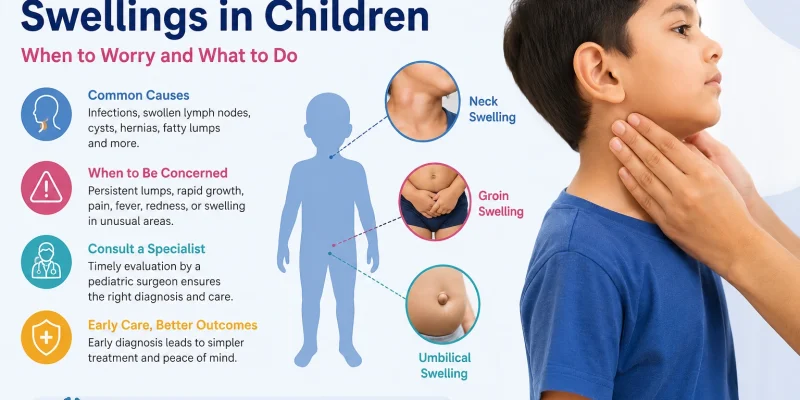
A neck swelling in child patients is one of the most common reasons parents seek a pediatric surgical opinion. Causes range from simple reactive lymph nodes to a thyroglossal duct cyst or branchial cleft cyst. Most neck lumps in children are benign, but a swelling that doesn’t shrink after two to three weeks should be examined.
Groin
Groin swelling in children is usually due to an inguinal hernia, hydrocele, or reactive lymph nodes. A hernia may become more noticeable when the child cries, coughs, or strains, and typically needs a surgical opinion even if it isn’t causing pain.
Umbilicus
An umbilical swelling baby presentation is extremely common in infants. Most umbilical hernias close on their own by age two to four. A soft, painless bulge that gets bigger with crying is usually harmless, but persistent swelling beyond this age range should be reviewed.
Chest and Back
Benign swellings here are usually lipomas, sebaceous cysts, or reactive lumps from minor skin infections. These are typically soft, mobile, and painless.
Hands and Legs
Cysts (such as ganglion cysts), lipomas, vascular swellings, and soft tissue masses can appear on the limbs. Most are slow-growing and painless, though any lump that restricts movement or grows quickly should be checked.
Difference Between Harmless and Serious Lumps
| Feature | Usually Harmless | Needs Evaluation |
| Growth | Stays the same size or shrinks | Grows rapidly over days/weeks |
| Pain | Painless | Painful or tender |
| Skin | Normal skin color | Red, warm, or discolored |
| Fever | Absent | Present |
| Mobility | Moves freely under the skin | Fixed to deeper tissue |
| Associated signs | None | Weight loss, night sweats, fatigue |
| Duration | Resolves in days to weeks | Persists beyond 3–4 weeks |
Risk Factors
Certain children may be more prone to lumps and swellings:
- Congenital conditions present at birth
- Prematurity
- Recurrent infections
- Family history of hernias or cysts
- Trauma or repeated injury to an area
- Underlying genetic disorders
How Pediatric Surgeons Diagnose Lumps
A thorough evaluation typically includes:
- Medical history — onset, duration, associated symptoms
- Physical examination — size, texture, mobility, tenderness
- Ultrasound — first-line imaging for most soft tissue and neck lumps
- Blood tests — to check for infection or inflammation
- X-ray — useful for certain bony or soft tissue evaluations
- MRI — detailed imaging for complex or deep swellings
- CT scan — used selectively for specific anatomical assessment
- FNAC (Fine Needle Aspiration Cytology) — sampling cells from a lump
- Biopsy — reserved only for cases where tissue diagnosis is essential
Treatment Options
Observation
Many lumps, especially small reactive lymph nodes or a small umbilical swelling baby presentation, simply need periodic monitoring.
Medicines
Antibiotics or anti-inflammatory medication may be prescribed when infection is the underlying cause.
Surgical Removal
Surgery becomes necessary when a lump is a hernia, growing steadily, causing symptoms, or needs tissue confirmation.
Pediatric Surgical Procedures
- Hernia repair — closing the weak point in the abdominal or groin wall
- Cyst excision — complete removal of the cyst, including its lining
- Lymph node biopsy — sampling or removing a node for diagnosis
- Soft tissue lump removal — excising lipomas or other benign masses
- Hydrocele surgery — draining and correcting the fluid collection
- Minor day-care procedures — many of these surgeries are done without an overnight hospital stay
Recovery After Surgery
- Hospital stay — most day-care procedures allow same-day discharge
- Pain management — mild pain relief medication for a few days
- Wound care — keeping the site clean and dry as advised
- Activity restrictions — limiting strenuous play for one to two weeks
- Follow-up visits — a wound check and confirmation of healing
- Expected recovery timeline — most children return to normal activity within one to two weeks
Long-Term Complications if Ignored
Delaying evaluation of a concerning lump can occasionally lead to:
- Spread of infection
- Hernia strangulation, a surgical emergency
- Cosmetic deformity from an enlarging cyst
- Airway compression from certain neck masses
- Damage to nearby organs or structures
- Delayed diagnosis of a serious underlying condition
Prevention Tips
- Maintain good hygiene to reduce skin and gland infections
- Treat infections early rather than waiting them out
- Keep up with routine pediatric checkups
- Monitor any new swelling for changes in size or texture
- Avoid delaying a specialist consultation once a lump is noticed
When Is It an Emergency?
Seek immediate medical care if your child has:
- Difficulty breathing
- Severe, sudden pain
- A swelling that rapidly increases in size
- High fever with the swelling
- Vomiting along with a groin swelling
- Blue or black discoloration over the lump
- Persistent bleeding from the area
- New swelling appearing after a major injury
Emergency Advice A groin swelling with vomiting, or a neck swelling causing breathing difficulty, should never wait for a scheduled appointment — go to an emergency department right away.
Common Mistakes Parents Should Avoid
- Ignoring a persistent lump, hoping it will resolve on its own
- Self-medicating without a proper diagnosis
- Applying home remedies or ointments without medical advice
- Delaying recommended surgery
- Assuming every lump means cancer
- Skipping follow-up appointments after treatment
Myths vs Facts
| Myth | Fact |
| Every lump is cancer | The vast majority of childhood lumps are benign |
| Swellings always disappear on their own | Some, like hernias, need surgical correction |
| Surgery is always risky | Modern pediatric day-care procedures are safe and minimally invasive |
| Hernias improve with medicines | Hernias require surgical repair, not medication |
Why Choose Dr. Antony Robert Charles
Parents look for a specialist who combines surgical skill with genuine warmth toward children, and Dr. Antony Robert Charles offers exactly that combination:
- Deep expertise in pediatric surgery and pediatric surgical oncology
- A child-friendly, anxiety-reducing approach to consultations
- Advanced diagnostic evaluation using ultrasound and other imaging
- Minimally invasive surgical techniques wherever possible
- Personalized treatment plans tailored to each child’s condition
- Comprehensive follow-up care through complete recovery
Why Parents Across Bangalore Trust Dr. Antony Robert Charles
Families from across Bangalore — including Marathahalli, Whitefield, Koramangala, Hebbal, and Sarjapur Road — regularly seek out Dr. Antony Robert Charles for evaluation of childhood lumps and swellings.
This trust comes from consistent, accessible, compassionate care paired with genuine surgical expertise. Whether the concern is a neck swelling in child, a groin swelling in children, or a case involving childhood cysts and lumps, families across these neighborhoods find both accurate diagnosis and a treatment plan built around their child’s comfort and long-term wellbeing.
For families searching for a reliable Pediatric surgeon Bangalore, proximity across these localities means specialist care is rarely more than a short drive away.
Key Takeaways
- Most childhood lumps are benign, but persistent or changing swellings deserve evaluation.
- Warning signs include rapid growth, pain, redness, fever, and breathing or swallowing difficulty.
- Common locations include the neck, groin, umbilicus, chest, back, hands, and legs.
- Diagnosis relies on history, examination, and imaging like ultrasound; biopsy is used only when necessary.
- Treatment ranges from simple observation to day-care surgical procedures.
- Ignoring certain lumps — especially hernias — can lead to preventable complications.
- Families across Bangalore, Marathahalli, Whitefield, Koramangala, Hebbal, and Sarjapur Road can access specialist pediatric surgical care close to home.
Frequently Aqsked Questions:
What causes a lump in child patients?
A lump in child patients may develop due to infections, enlarged lymph nodes, congenital cysts, hernias, lipomas (fatty lumps), or other benign conditions. While most childhood lumps are harmless, persistent or enlarging swellings should be assessed by a pediatric surgeon for an accurate diagnosis.
When should parents worry about a neck swelling in child?
A neck swelling in child should be evaluated if it lasts longer than two to three weeks, increases in size, feels hard or fixed, or is associated with fever, pain, difficulty swallowing, breathing problems, or unexplained weight loss.
Does a groin swelling in children always require surgery?
Not every groin swelling requires immediate surgery. However, an inguinal hernia usually needs surgical repair because it does not heal on its own and may become trapped, leading to complications. Early evaluation helps determine the most appropriate treatment.
When should I consult a Pediatric Surgeon in Bangalore for my child's swelling?
You should consult a Pediatric Surgeon in Bangalore if your child's lump grows rapidly, becomes painful, causes redness or fever, interferes with normal activities, or remains present after several weeks. Early assessment ensures timely diagnosis and appropriate treatment.
Why does my child have a lump that won't go away?
A persistent lump may be due to a reactive lymph node, congenital cyst, benign soft tissue swelling, or another underlying condition. Although many are not serious, a lump that does not disappear should be examined by a pediatric surgeon to identify the exact cause.
Is every swelling in children dangerous?
No. Most swellings in children are harmless and commonly result from enlarged lymph nodes, fatty lumps, or minor infections. However, any swelling that is rapidly growing, painful, hard, or accompanied by fever or other concerning symptoms should be evaluated promptly.
Can an umbilical swelling in babies heal without surgery?
Yes. Most umbilical hernias in babies close naturally between 2 and 4 years of age. Surgery is usually recommended only if the swelling persists beyond this age, becomes very large, causes discomfort, or develops complications.
Who is the best Pediatric Surgeon in Bangalore for evaluating childhood lumps and swellings?
Dr. Antony Robert Charles is a highly experienced Pediatric Surgeon in Bangalore, providing expert evaluation and child-friendly treatment for lumps, cysts, hernias, and swellings in children. He serves families across Marathahalli, Whitefield, Koramangala, Hebbal, and Sarjapur Road with compassionate, evidence-based pediatric surgical care.